
The cost of moving to Austin versus San Antonio depends on your starting address, household size, moving services, and destination home—not just which city you choose. For your 2026 budget, compare written moving estimates alongside the cash needed to rent or buy; a lower moving estimate does not necessarily mean a lower total relocation cost. Keep recurring housing expenses separate so you can see both what gets you there and what supports your life afterward.
- Compare the cost of moving to Austin vs San Antonio using the same inventory, dates, and service level.
- Separate moving expenses, housing setup, and recurring household bills before choosing a destination.
- April Guerra offers residential real estate guidance for buyers and sellers considering Austin and San Antonio.
- Choose the address that fits your housing budget and daily routine, not simply the lower moving estimate.
Why this matters
A relocation budget answers two different questions: what you need to complete the move, and what you need to live comfortably after it. Mixing those questions makes a city comparison harder than it needs to be.
I recommend building the budget around actual homes and your actual routine. An Austin address close to work and a San Antonio address requiring a different commute are not interchangeable options, even when the homes look similar online.
April Guerra provides residential real estate services for buyers and sellers in the Austin and San Antonio areas. You can learn more about that local focus on the About April Guerra page.
How much does moving to Austin cost versus San Antonio?
There is no single citywide moving total that answers this question for your household. Compare the same move to each destination, then add the housing and setup expenses attached to the specific property.
The distinction matters: transporting your belongings is a service quote, while establishing a home involves separate payments, agreements, and ongoing obligations. Use this table to organize your 2026 comparison without treating either city as automatically cheaper.
| Budget category | Austin comparison | San Antonio comparison | What to check |
|---|---|---|---|
| Moving service | Written estimate to the Austin address | Written estimate to the San Antonio address | Same inventory, dates, packing, and service scope |
| Property access | Conditions at the Austin property | Conditions at the San Antonio property | Stairs, elevators, parking, and loading access |
| Rental setup | Terms for the specific Austin rental | Terms for the specific San Antonio rental | Required payments, lease dates, and included services |
| Home purchase | Financing and transaction details for the Austin home | Financing and transaction details for the San Antonio home | Lender estimates, insurance quotes, and property documents |
| Transition | Travel and timing around the Austin move | Travel and timing around the San Antonio move | Housing overlap, storage, and temporary accommodation |
| Ongoing living | Expenses tied to the Austin address | Expenses tied to the San Antonio address | Housing, utilities, transportation, and relevant property charges |
Neither column wins until you fill it with comparable information. A quote for full packing in one city cannot fairly compete with a transportation-only quote in the other.
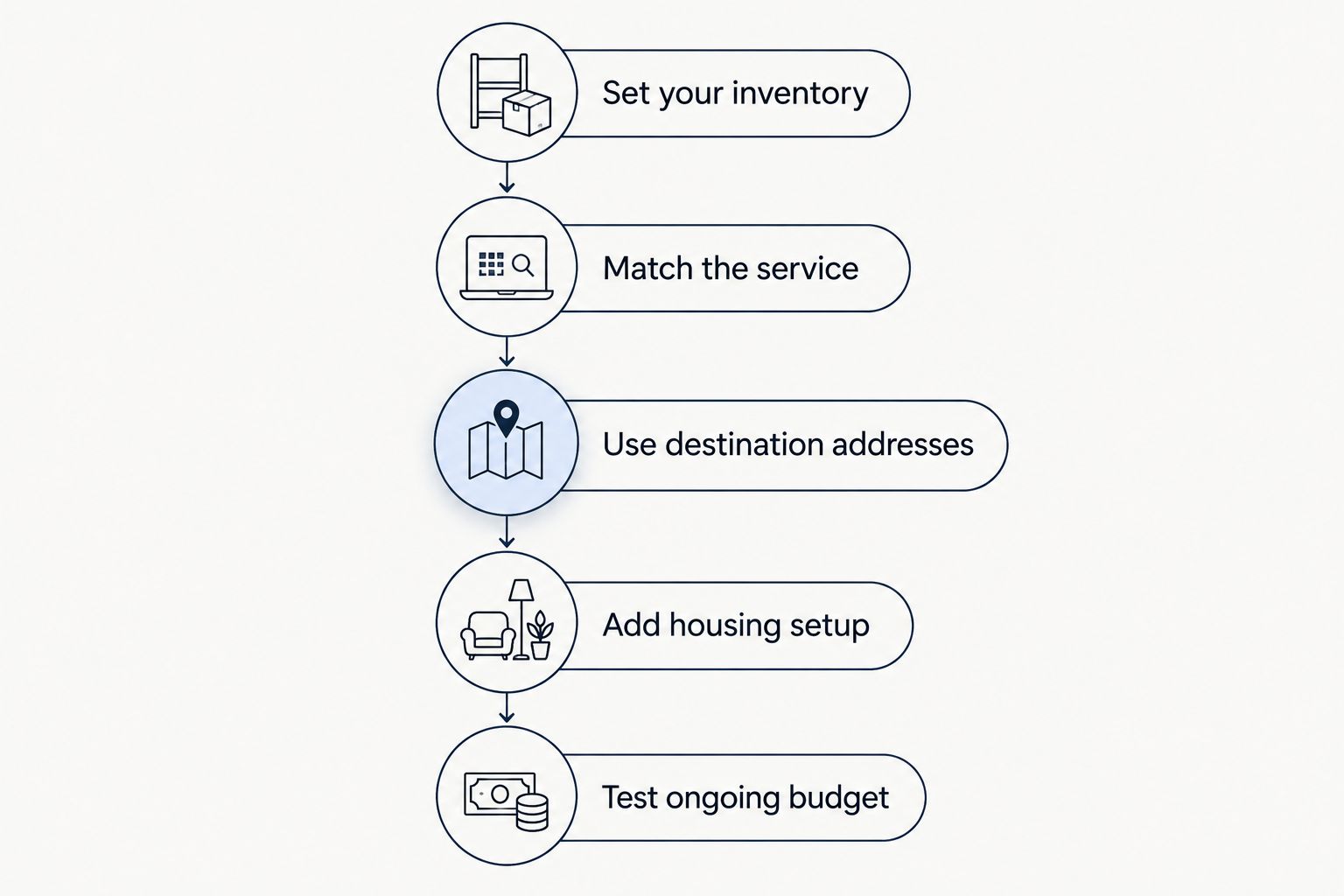
Build your comparison in this order
- Set your inventory. List the furniture, boxes, and belongings you intend to move. Identify anything needing special handling before requesting estimates.
- Match the service. Ask each mover to quote the same packing, loading, transport, and unloading responsibilities. Make exclusions visible.
- Use destination addresses. Give the mover the property access details, not just the city name. Confirm how changes to those details affect the estimate.
- Add housing setup. Use the lease, lender documents, insurance quotes, and other property-specific information to identify required payments.
- Test the ongoing budget. Check whether the household expenses attached to that address still fit after the move is complete.
Keep an assumptions column beside your totals. If you have not chosen a property, label housing figures as placeholders rather than letting them look as certain as a written moving estimate.
Moving into a rental: compare the lease and the move
For a rental, build your arrival budget from the actual lease terms. Identify required payments, when they are due, and which services you need to arrange separately.
Then check how the rental handles move-in access. Ask about loading locations, elevator reservations where relevant, and any building requirements your mover needs to know. Getting those details settled before booking keeps the estimate aligned with the job.
Renting is best for someone who wants a rental arrangement while establishing a Central Texas routine. The trade-off is that lease obligations still shape your flexibility; renting does not mean you can change plans without checking the agreement.
For either city, ask yourself:
- Does the lease start when you can actually move?
- Will you pay for your current home and the new rental during the same period?
- Which utilities or services are included, and which need separate accounts?
- Does the property's move-in process match the mover's proposed schedule?
Keep refundable deposits separate from nonrefundable expenses in your worksheet. Both affect the cash you need at arrival, but they do not represent the same kind of expense.
Buying a home: compare the property, not the city label
For a purchase, moving expenses belong beside—not inside—your homebuying calculations. Ask your lender to explain your estimated cash to close and ongoing payment, then identify separate relocation expenses that the lender's documents do not cover.
Use property-specific tax information and insurance quotes. If an owners association applies, review its documents and charges rather than assuming the home follows the same arrangement as another property nearby.
Buying is best for someone ready for the responsibilities and commitments of homeownership. Ownership gives you a different relationship with the property, but it also places maintenance and repair planning in your household budget.
Avoid comparing homes using the mortgage payment alone. Ask what that payment includes, what remains separate, and which estimates need updating as the transaction progresses.
For your Austin-versus-San-Antonio decision, the useful comparison is between homes you would genuinely consider buying. A citywide impression cannot tell you what a particular home requires financially or how it fits your weekday life.
Why moving costs vary between Austin and San Antonio
Your 2026 moving comparison becomes more useful when every difference has an explanation. These factors belong in the questions you ask movers and housing providers:
- Starting location and route. Both destinations need estimates from the same origin. Ask how transportation is calculated rather than assuming the city name determines the result.
- Household inventory. Furniture, boxes, and special-handling items define the job. Keep the inventory consistent across estimates.
- Service scope. Packing, unpacking, storage, and other requested services change what you are comparing. Confirm which responsibilities remain yours.
- Property access. Describe stairs, elevators, loading areas, and the distance between parking and the home. Ask how access conditions are handled in the estimate.
- Timing and overlap. Your lease, closing, travel, and move dates determine whether you need overlapping housing or another transition arrangement.
- Destination housing obligations. Lease terms, purchase documents, insurance, and applicable property charges belong to the chosen home, not to a generic city budget.
When estimates differ, ask for the reason in writing. A useful explanation identifies a service, assumption, or property condition you can check; a headline total alone does not.
How do I compare Austin and San Antonio fairly?
Compare specific addresses using the same household needs. Start with your nonnegotiables—work location, space, accessibility, and other daily commitments—then evaluate homes that satisfy them.
I would keep the worksheet simple: one column for each address, with separate sections for moving, housing setup, and ongoing expenses. That gives you room to compare the trade-offs without pretending every concern has a dollar value.
A home that fits your budget but complicates essential routines deserves a closer look. Test the trips you actually expect to make, using the days and times relevant to your schedule, rather than relying on a general impression of either city.
Should I rent before buying in Austin or San Antonio?
Rent first if a rental arrangement fits your plans while you decide where to buy. Buy when you are ready to evaluate a specific property's financing, condition, location, and ownership responsibilities.
| Option | Best for | Practical advantage | Trade-off to budget for |
|---|---|---|---|
| Rent before buying | A household still deciding on its longer-term home | Lets you establish a local routine before choosing a purchase | A later purchase involves another transition and potentially another move |
| Buy for the relocation | A household ready to commit to a specific home | Aligns the relocation with the intended ownership plan | Requires purchase decisions and transaction timing alongside the move |
Neither approach is a shortcut around planning. Choose the arrangement that fits your readiness, not the one that makes the first moving worksheet look simpler.
What should I ask before booking a mover?
Ask what the written estimate includes, which assumptions it uses, and what happens if the inventory, date, or access conditions change. Also ask the mover to explain its applicable responsibility for loss or damage and the choices available to you.
Keep the estimate and any updates together. Before accepting, check that the origin, destination, service scope, and schedule match the move you intend to make.
Do not choose between Austin and San Antonio based on moving estimates that describe different jobs. Resolve differences in scope first; then compare the totals and terms.
Talk through the housing side before committing
April Guerra is a fit for Central Texas buyers and sellers seeking residential real estate guidance in Austin or San Antonio. That support belongs on the housing side of your decision; your mover, lender, insurer, and other providers should explain their own estimates and terms.
If you are weighing a purchase, sale, or relocation, I welcome a conversation about the homes and communities you are considering. Bring your priorities and the questions that are making the decision difficult.
Discuss your Central Texas move
Talk through buying, selling, or relocating in the Austin and San Antonio areas.
FAQ
Is moving to Austin cheaper than moving to San Antonio?
Neither city is automatically cheaper for your move. Compare written estimates using the same origin, inventory, service scope, dates, and destination access details.
What should my 2026 relocation budget include?
Your 2026 relocation budget should separate moving services, housing setup, transition arrangements, and recurring household expenses. Use actual estimates and property documents wherever possible.
Does a moving estimate include the money I need to rent a home?
A moving estimate does not replace a rental arrival budget. Check your lease for required payments and identify any separate utility or service arrangements.
Should I compare mortgage payments when choosing between Austin and San Antonio?
Compare the full property-specific household budget, not mortgage payments alone. Ask what each lender estimate includes, then account for separate insurance, applicable property charges, utilities, and maintenance planning.
Can I compare moving estimates before choosing a home?
You can begin comparing estimates before choosing a home, but confirm the destination and access assumptions with each mover. Update the estimate when the actual property and move details are settled.
Is renting first better when relocating to Central Texas?
Renting first fits households that want a rental arrangement while deciding where to buy. Include the lease obligations and a possible later move in your comparison.
Can April Guerra help me decide between Austin and San Antonio?
April Guerra offers residential real estate services for buyers and sellers in the Austin and San Antonio areas. A consultation can focus on your housing priorities and the communities you are considering.
One last thing
Cash needed is not the same as money permanently spent. A refundable deposit can affect what you need available on moving day without being equivalent to a nonrefundable service charge. Likewise, money associated with a home purchase should not all be treated as a transportation expense.
Before finalizing your 2026 plan, mark each worksheet entry as a one-time expense, a refundable payment, a purchase-related payment, or a recurring bill. That small distinction makes your Austin-versus-San-Antonio comparison clearer—and gives you better questions to ask before committing.
Related guides
Written by April Guerra.